Introduction
Have you ever picked up your phone to check one notification and then realized 30 minutes had disappeared?
You’re not alone.
In today’s connected world, people spend hours every day scrolling through social media, checking emails, watching videos, and switching between apps. While technology has made life easier in many ways, it has also created new challenges. Constant notifications, endless content, and digital distractions can make it difficult to focus, stay productive, and maintain mental well-being.
This is where digital minimalism comes in.
Digital minimalism is not about abandoning technology. Instead, it’s about using technology intentionally and removing digital clutter that doesn’t add value to your life.
The simple answer is this:
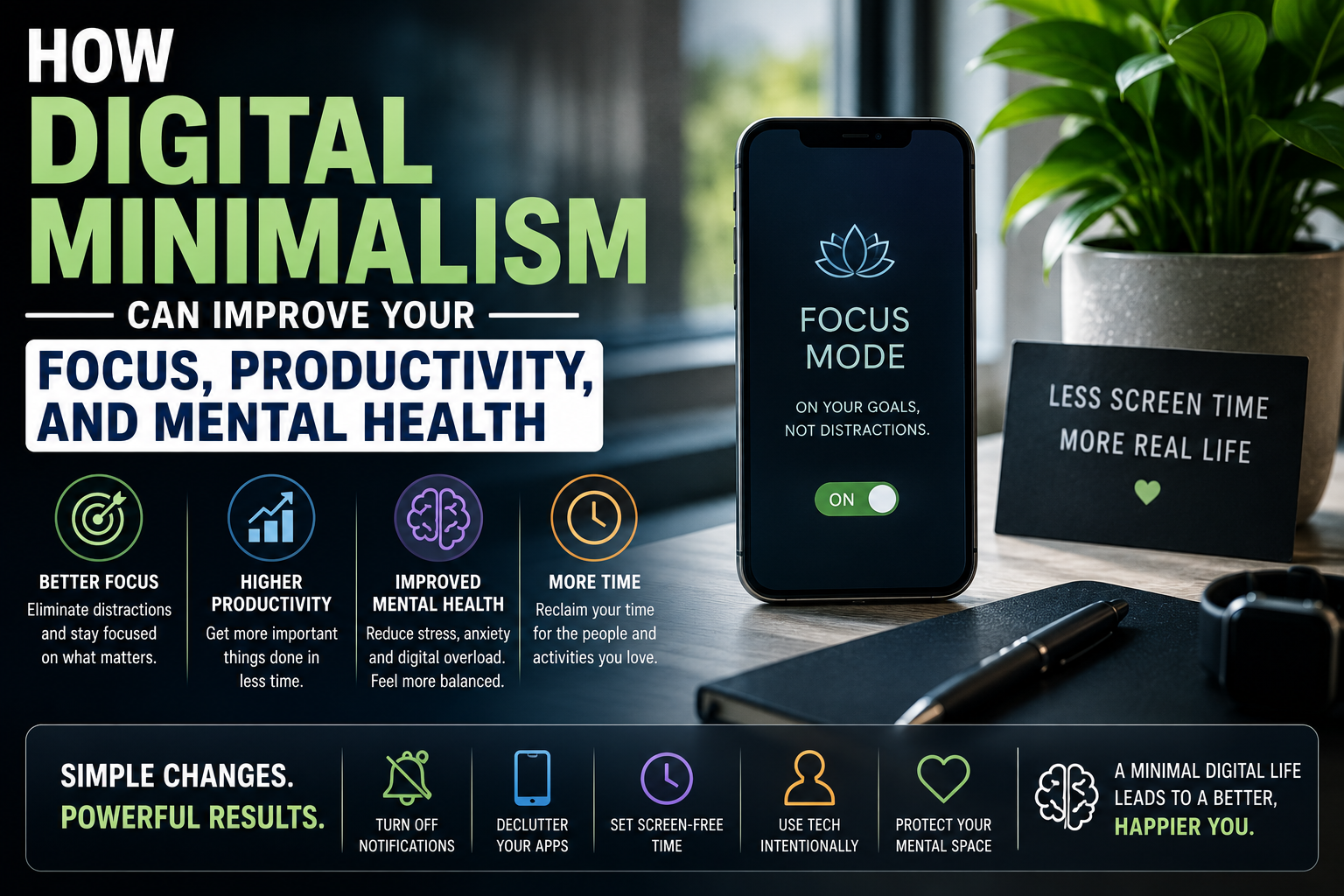
Digital minimalism helps people regain control of their time, improve focus, reduce stress, and build a healthier relationship with technology.
Let’s explore how this growing lifestyle trend can improve your daily life in 2026 and beyond.
What Is Digital Minimalism?
Digital minimalism is a philosophy that encourages people to use technology with purpose.
Instead of allowing apps, notifications, and online platforms to control attention, digital minimalists choose tools that genuinely support their goals and values.
This approach focuses on:
- Intentional technology use
- Reducing unnecessary screen time
- Eliminating digital distractions
- Prioritizing meaningful activities
The goal isn’t to avoid technology.
The goal is to make technology serve you rather than the other way around.
Why Digital Overload Is Becoming a Problem
Technology companies compete for attention.
Every day, people receive:
- Social media notifications
- Emails
- Messages
- News alerts
- App updates
This constant stream of information can overwhelm the brain.
Many people experience:
- Reduced concentration
- Increased stress
- Mental fatigue
- Lower productivity
The more distractions compete for attention, the harder it becomes to focus on important tasks.
How Digital Minimalism Improves Focus
One of the biggest benefits of digital minimalism is improved concentration.
Fewer Interruptions
Every notification breaks attention.
Research consistently shows that regaining focus after an interruption can take several minutes.
By reducing notifications, people can stay engaged with important work for longer periods.
Better Deep Work
Deep work refers to focused, distraction-free effort.
Whether studying, writing, or solving problems, uninterrupted concentration often leads to better results.
Digital minimalism creates an environment where deep work becomes easier.
Improved Decision-Making
Constant digital stimulation can create mental clutter.
A simpler digital environment often helps people think more clearly and make better decisions.
Digital Minimalism and Productivity
Many people believe being connected all the time makes them more productive.
In reality, the opposite is often true.
Less Multitasking
Switching between tasks reduces efficiency.
Digital minimalism encourages single-task focus, which often leads to higher-quality work.
Better Time Management
When distractions decrease, more time becomes available for meaningful activities.
Many people are surprised by how much time they recover after reducing unnecessary screen usage.
Improved Prioritization
Digital minimalists tend to spend more time on important goals rather than reacting to constant online distractions.
Mental Health Benefits
Technology itself isn’t the problem.
The issue often comes from excessive and unintentional usage.
Reduced Stress
Constant notifications can create a feeling of urgency.
A quieter digital environment often reduces anxiety and stress.
Better Sleep
Many people use phones late into the night.
Reducing screen time before bed can improve sleep quality.
Lower Comparison Pressure
Social media often encourages unhealthy comparisons.
Spending less time on these platforms can improve self-confidence and emotional well-being.
Greater Mindfulness
Digital minimalism helps people become more present in everyday experiences.
Practical Signs You May Need Digital Minimalism
You might benefit from digital minimalism if:
- You frequently check your phone without a reason.
- Notifications constantly interrupt your work.
- Social media consumes more time than intended.
- You struggle to focus on tasks.
- Screen time leaves you feeling exhausted.
Recognizing these habits is the first step toward positive change.
Simple Ways to Practice Digital Minimalism
Turn Off Non-Essential Notifications
Most notifications are not urgent.
Removing unnecessary alerts can significantly reduce distractions.
Declutter Your Apps
Delete apps you rarely use.
Keep only those that provide genuine value.
Create Screen-Free Periods
Set aside times during the day without technology.
Examples include:
- During meals
- Before bedtime
- While exercising
Use Technology Intentionally
Before opening an app, ask yourself:
“What am I trying to accomplish?”
This simple question encourages mindful usage.
Limit Social Media Consumption
You don’t necessarily need to quit social media.
Instead, create healthy boundaries around usage.
What Digital Minimalism Is Not
There are several misconceptions about digital minimalism.
It’s Not Anti-Technology
Digital minimalists still use technology.
They simply use it more intentionally.
It’s Not About Perfection
You don’t need to eliminate every distraction.
Small improvements can produce meaningful results.
It’s Not Only for Professionals
Students, parents, entrepreneurs, and retirees can all benefit.
Anyone who uses technology regularly can apply these principles.
Real-World Example
Imagine two people working from home.
The first person receives dozens of notifications every hour, checks social media frequently, and constantly switches tasks.
The second person disables unnecessary notifications, schedules focused work sessions, and uses technology intentionally.
Over time, the second individual is likely to experience:
- Better focus
- Higher productivity
- Less stress
- Improved work quality
This example illustrates why digital minimalism is gaining popularity worldwide.
The Future of Digital Wellness
As technology becomes more integrated into daily life, digital wellness will become increasingly important.
Many experts predict future trends such as:
- More focus-friendly apps
- Enhanced digital well-being tools
- Improved screen-time management
- Greater awareness of healthy technology habits
Digital minimalism may become an essential life skill in the years ahead.
FAQ
1. What is digital minimalism?
Digital minimalism is the intentional use of technology while reducing unnecessary digital distractions.
2. Does digital minimalism mean deleting social media?
Not necessarily. It focuses on using social media intentionally rather than excessively.
3. Can digital minimalism improve productivity?
Yes. Reducing distractions often helps people focus and work more effectively.
4. How does digital minimalism help mental health?
It can reduce stress, improve sleep, and create a healthier relationship with technology.
5. Is digital minimalism difficult to start?
No. Small changes such as disabling notifications and reducing screen time can make a significant difference.
Conclusion
Technology is one of the most powerful tools ever created, but using it without limits can negatively affect focus, productivity, and mental health.
Digital minimalism offers a practical solution by encouraging intentional technology use and reducing unnecessary distractions.
The goal isn’t to reject technology. It’s to use it wisely.
By making small adjustments to digital habits, people can regain control of their attention, improve daily productivity, and create more space for meaningful experiences.
In a world filled with constant notifications and endless content, digital minimalism may be one of the most valuable habits you can develop.
Related Resources
Daily Nest
https://dailynest.tech/
About the Author