Meta Description
Discover how AI is changing education for students in 2026. Learn how smart learning tools, personalized study methods, and AI-powered platforms are transforming modern education.
How AI Is Changing Education for Students in 2026 | Smart Learning Guide
Introduction
A few years ago, studying usually meant carrying heavy books, searching through endless websites, and spending hours trying to understand difficult topics alone. If you got stuck on a math problem or couldn’t understand a science concept, your options were limited. You either waited until the next class or asked someone for help.
Today, things are very different.
Many students now have access to AI-powered learning tools that can explain complex topics within seconds, create personalized study plans, and even help identify weak areas before an exam. What once sounded like science fiction is quickly becoming a normal part of education.
I recently noticed something interesting while talking to a university student. Instead of spending hours watching random videos online, he used an AI study assistant to organize his notes, summarize long chapters, and create practice questions. According to him, it didn’t replace studying—it simply made studying more effective.
That perfectly explains why Artificial Intelligence is having such a big impact on education. The goal isn’t to replace teachers or classrooms. The goal is to help students learn smarter, faster, and more efficiently.
As we move through 2026, AI is becoming one of the most important tools in modern education.
The Traditional Learning Model Is Changing
For decades, most classrooms followed the same structure.
A teacher explained a lesson, students took notes, completed assignments, and prepared for exams. While this approach has helped millions of students, it has always had one major limitation: every student learns differently.
Some students understand new concepts immediately. Others need extra explanations, examples, or additional practice.
The problem is that a single classroom cannot always adapt to every student’s learning style.
This is where AI is creating new opportunities.
Instead of forcing every learner to follow the same path, modern educational technology can adapt to individual needs. AI systems can identify strengths, weaknesses, learning speed, and study habits. This allows students to receive a more personalized learning experience.
For many learners, that can make a huge difference.
Personalized Learning Is Becoming More Powerful
One of the biggest advantages of AI in education is personalization.
Imagine two students preparing for the same exam.
One student struggles with mathematics but enjoys science. Another student performs well in mathematics but finds science difficult.
Traditionally, both students would receive the same lessons and assignments.
With AI-powered learning platforms, the experience can be customized.
If a student repeatedly makes mistakes in a particular topic, the system can automatically provide additional explanations, practice exercises, and revision materials.
This doesn’t just improve performance—it also reduces frustration.
Students often lose confidence when they feel left behind. Personalized learning helps create a more supportive environment where learners can progress at their own pace.
Many education experts believe this approach could become one of the most important improvements in modern learning.
AI Study Tools Are Helping Students Save Time
Most students would agree that one of the biggest challenges in education is managing time.
Assignments, exams, projects, notes, presentations, and extracurricular activities can quickly become overwhelming.
AI tools are helping students manage these responsibilities more effectively.
Today, students use AI for:
- Summarizing long chapters
- Creating revision notes
- Generating practice questions
- Building study schedules
- Explaining difficult concepts
For example, a student preparing for final exams might have hundreds of pages of material to review.
Instead of spending hours organizing notes manually, AI can quickly create summaries and highlight key information.
This allows students to spend more time understanding concepts and less time sorting information.
Of course, the most successful students use AI as a study assistant—not as a shortcut. Learning still requires effort, critical thinking, and practice.
But when used correctly, AI can remove many unnecessary obstacles from the learning process.
Why Teachers Are Also Benefiting From AI
Whenever people discuss Artificial Intelligence in education, the conversation usually focuses on students.
However, teachers are also experiencing major benefits.
Teaching involves far more than delivering lessons.
Teachers spend countless hours:
- Preparing lesson plans
- Creating quizzes
- Reviewing assignments
- Tracking student progress
- Managing classroom resources
Many of these tasks are repetitive and time-consuming.
AI can automate some of this work, allowing teachers to focus more on teaching and student engagement.
Several schools are already using AI tools to generate assessment materials, analyze performance data, and identify students who may need additional support.
Rather than replacing educators, AI is helping them become more efficient.
And that is an important distinction that often gets overlooked.
Online Learning Is Becoming Smarter Than Ever
Not long ago, online learning platforms were simply digital versions of classrooms. Students watched recorded videos, completed assignments, and moved on to the next lesson.
Today, AI is changing that experience completely.
Modern learning platforms can track student progress, identify weak areas, and recommend lessons based on individual performance. Instead of following the same learning path as everyone else, students receive a more personalized experience.
For example, if a learner struggles with grammar but performs well in reading comprehension, the platform can automatically suggest additional grammar exercises while reducing unnecessary practice in areas where the student is already strong.
This makes learning more efficient and helps students stay motivated.
One of the biggest reasons students quit online courses is feeling overwhelmed or lost. AI-powered systems help solve this problem by guiding learners step by step through their educational journey.
Breaking Language Barriers in Education
Education should be available to everyone, regardless of language.
Unfortunately, many students around the world still face challenges because educational resources are often available only in a few major languages.
AI-powered translation tools are helping change that.
Students can now translate lessons, articles, and study materials almost instantly. They can watch educational videos with translated subtitles and access learning resources that were previously difficult to understand.
This creates new opportunities for millions of learners.
A student living in a small town can now access information from universities, researchers, and educators across the world. That level of accessibility was difficult to imagine just a few years ago.
In many ways, AI is making education more global and inclusive.
AI Is Helping Students Prepare for Exams More Effectively
Ask any student what causes the most stress, and exams will probably be near the top of the list.
Many students spend weeks preparing but still struggle because they don’t know where to focus their attention.
AI-powered study tools can analyze learning patterns and identify areas that need improvement.
Instead of revising every topic equally, students can focus on subjects where they need the most help.
Some AI platforms even generate personalized quizzes based on previous mistakes. This allows learners to strengthen weak areas before the actual exam.
From my experience, students often waste time studying everything instead of studying strategically. AI is helping many learners become more focused and organized in their preparation.
The result is not just better grades but also reduced stress and improved confidence.
Developing Skills Beyond the Classroom
Education is no longer limited to textbooks and exams.
Students today need skills such as:
- Communication
- Critical thinking
- Problem-solving
- Creativity
- Digital literacy
AI tools can support the development of these skills in interesting ways.
For example, students can use AI to practice writing, brainstorm project ideas, explore different viewpoints, and receive instant feedback on their work.
This encourages independent learning and helps students become more confident learners.
The ability to learn continuously is becoming one of the most valuable skills in modern society, and AI is making that process easier.
Challenges Schools Must Still Address
Despite all the advantages, AI is not a perfect solution.
There are still important challenges that schools, students, and parents must consider.
Over-Reliance on Technology
One concern is that students may become too dependent on AI tools.
If learners rely on AI for every answer, they may miss opportunities to develop critical thinking and problem-solving skills.
Technology should support learning, not replace genuine understanding.
Accuracy and Misinformation
AI systems can occasionally provide inaccurate information.
Students must learn how to verify facts and use reliable sources.
Learning how to question information is just as important as finding information.
Digital Access and Equality
Not every student has access to high-speed internet, modern devices, or premium educational tools.
As AI becomes more common, ensuring equal access will become an important challenge for education systems worldwide.
What Will Classrooms Look Like in the Future?
The classroom of the future may look very different from today’s classrooms.
Experts predict that future schools could include:
- AI-powered learning assistants
- Personalized lesson plans
- Virtual and augmented reality learning experiences
- Real-time performance analysis
- Smart educational platforms
However, one thing is unlikely to change.
Students will still need teachers.
Human guidance, mentorship, encouragement, and real classroom interaction remain essential parts of education. Technology can enhance learning, but it cannot fully replace the human connection that great teachers provide.
The future is not about choosing between AI and teachers. It is about combining both to create better learning experiences.
Conclusion
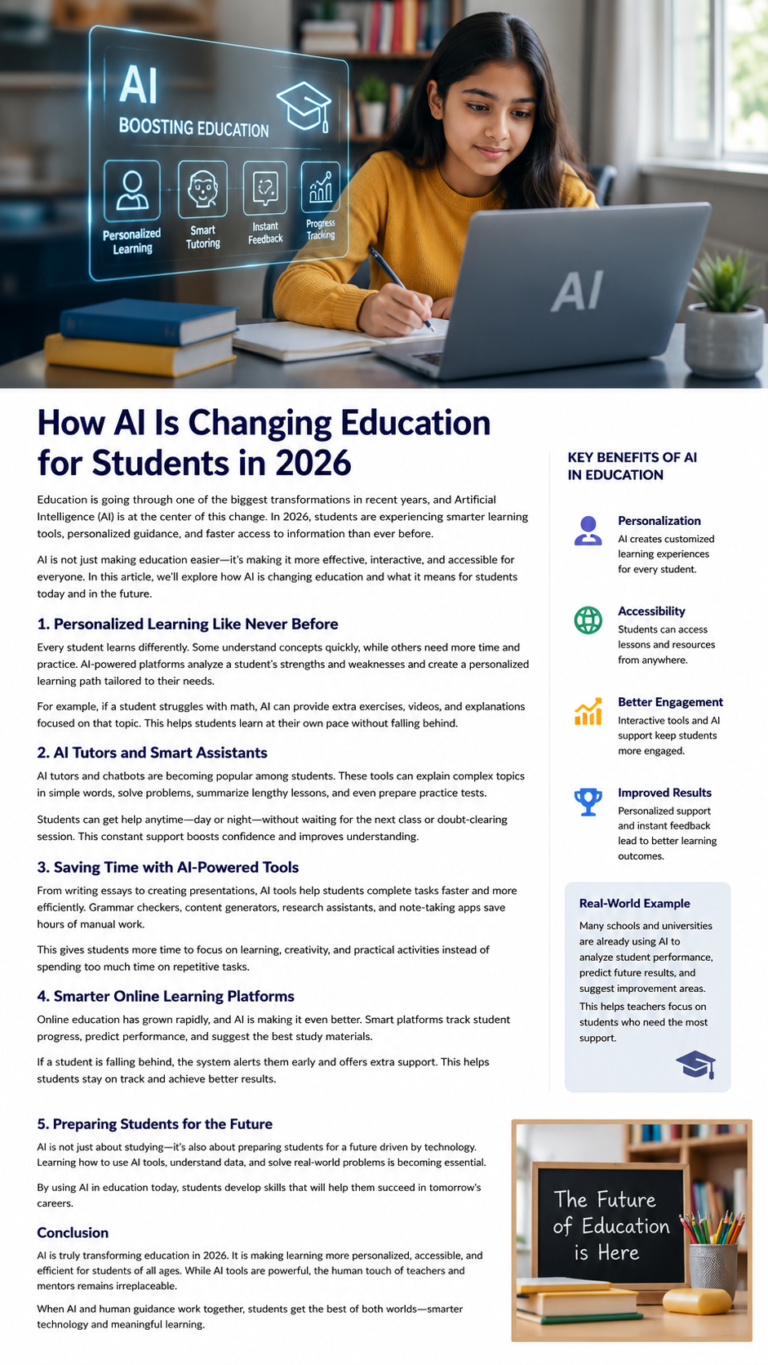
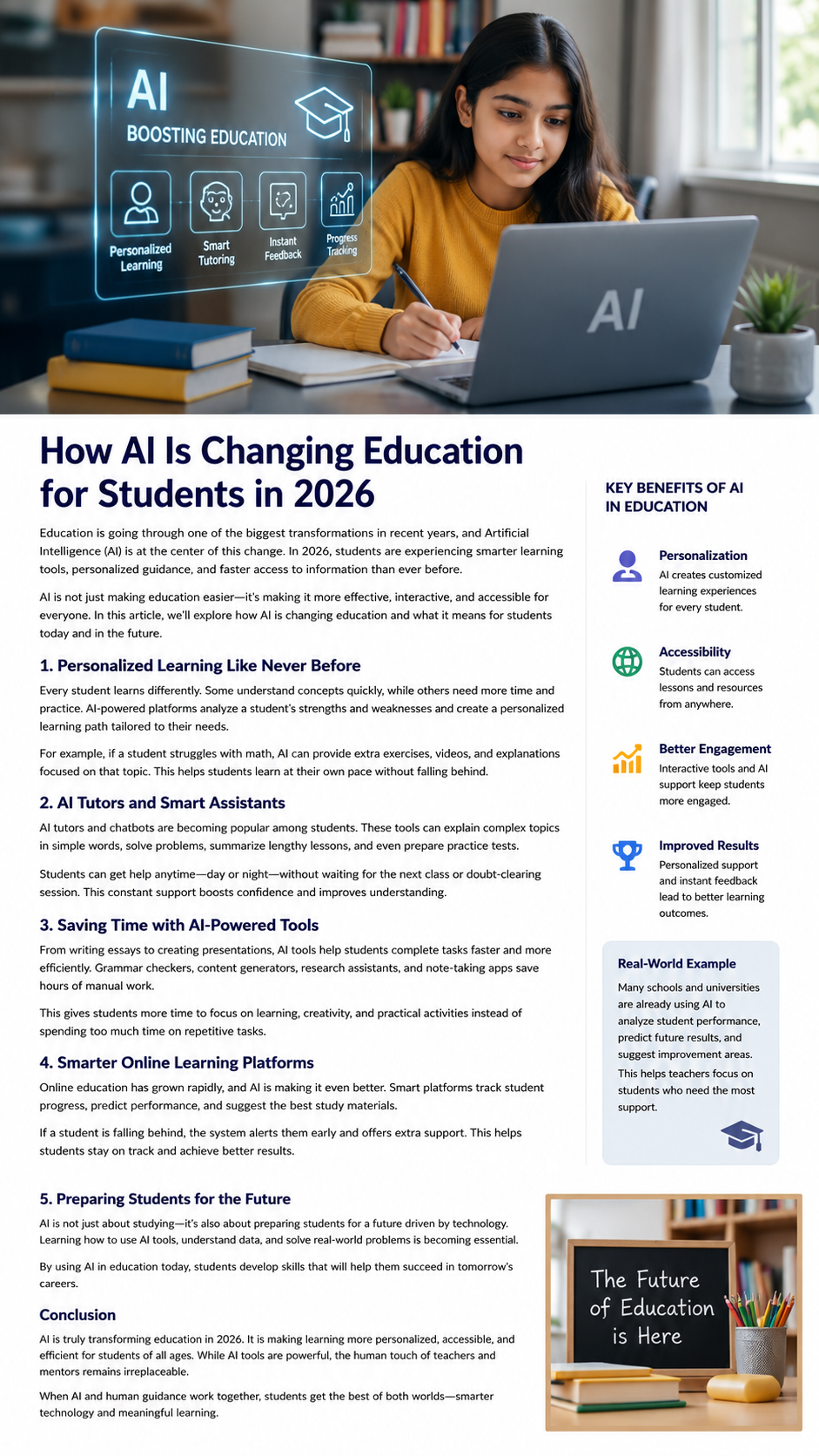
Artificial Intelligence is transforming education in ways that are already making a real difference for students around the world. From personalized learning and smarter study tools to improved online education and language accessibility, AI is helping students learn more effectively than ever before.
At the same time, successful learning still depends on curiosity, effort, discipline, and critical thinking. AI can provide support, guidance, and efficiency, but it works best when students actively participate in their own education.
As technology continues to evolve, the schools and students who learn how to use AI wisely will have significant advantages. The future of education is not about replacing people with technology—it is about using technology to help people reach their full potential.
About the Author